
WooCommerce service

WooCommerce ERP, CRM & WMS Integration

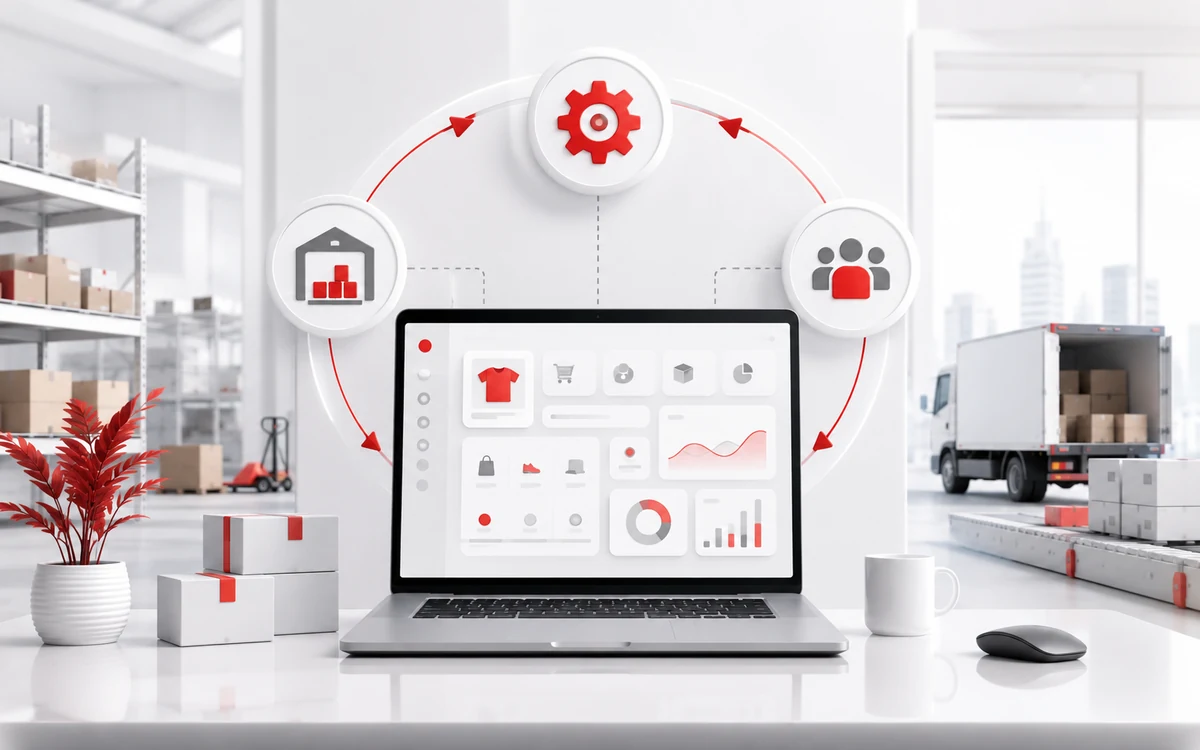
Make WooCommerce part of the operational backbone of your company. We connect the storefront with ERP, warehouse and CRM systems so information moves automatically and predictably.

WooCommerce ERP, CRM & WMS Integration
Why this becomes difficult

ERP integration is about business rules, not just data transfer

Products, variants, prices, stock levels and orders may look simple in WooCommerce, but the corresponding entities in ERP or WMS often have different identifiers, statuses, units, warehouses and validation rules.

A useful integration therefore needs a data model, conflict rules, synchronization priorities and clear handling of partial errors. The goal is to reduce manual work without creating a black box that nobody can support later.

Stock and warehouse synchronization
Product and variant import or update
Price lists and B2B pricing from ERP
Order export and fulfillment status import
Customer and company account synchronization
Multi-warehouse and reservation logic
Scope

What we can implement

The exact scope depends on your current architecture and business process. These are the areas we most often cover.

Core implementation

  • Stock and warehouse synchronization
  • Product and variant import or update
  • Price lists and B2B pricing from ERP
  • Order export and fulfillment status import
  • Customer and company account synchronization
  • Multi-warehouse and reservation logic

Technical considerations

  • One-way or two-way sync
  • Queues, jobs and webhooks
  • Multi-warehouse scenarios
  • Migration from CSV/XML exchanges

Good fit when

  • ERP or WMS is the source of truth for products, prices or stock.
  • Orders must reach warehouse, finance or CRM automatically.
  • The current synchronization is hard to debug or reconcile.
Engineering notes

The integration details that usually decide whether it stays reliable

Most ERP projects fail on small assumptions: identifiers, variants, reservations, partial fulfillment and unclear data ownership.

01

Identifiers and mapping

SKU is not always enough. We define stable IDs for products, variants, customers, warehouses and documents.

02

Stock semantics

Available, physical and reserved stock are different values. We map the one that should actually control storefront availability.

03

Order lifecycle

We model partial shipments, cancellations, returns and status changes instead of assuming every order is fulfilled once and completely.

04

Reconciliation

The integration should make it possible to compare both systems and identify missing or inconsistent records.

Real-world signals

What usually tells us the standard setup is no longer enough

We do not start with a technology choice. We start with the failure mode, the business rule and the evidence.

Warehouse stock and WooCommerce stock disagree

We verify source-of-truth rules, reservations, update frequency and race conditions.

The ERP receives incomplete or differently formatted orders

We map tax, discount, shipping, product and customer identifiers field by field.

Staff still repairs synchronization manually

We look for missing queues, error states, replay tools and ownership of failed records.

Acceptance criteria

How we know the work is actually finished

A deployment is not “done” because the happy path worked once. We agree what must remain true in production.

  • Product and order identifiers map deterministically between systems.
  • Inventory updates have a documented conflict strategy.
  • Failed jobs are visible and recoverable.
  • Cutover includes a reconciliation check, not just a successful API response.
Delivery process

A technical process built around risk and maintainability.

1. Identify sources of truth

We define whether WooCommerce, ERP or WMS owns products, stock, prices, customers and order status.

2. Map entities and events

We document identifiers, warehouses, tax fields, statuses and triggers for each synchronization.

3. Build a resilient sync engine

The integration uses queues, retries and logs where the process cannot depend on one HTTP request.

4. Validate with real data

We test edge cases on realistic catalog and order data before production launch.

Typical deliverables

Working software, clearer ownership and fewer hidden dependencies.

The engagement should leave you with working software and a clearer technical situation than before.

Data mapSync engineOperational logsRecovery procedure
FAQ

Questions we hear before starting

Which ERP systems can you integrate with WooCommerce?

We are not limited to one vendor. The key question is what integration interface the ERP provides and which data should be exchanged.

Can stock be synchronized from several warehouses?

Yes. Multi-warehouse logic can be mapped to WooCommerce availability, reservations or custom fulfillment rules.

Can ERP remain the only place where prices are managed?

Yes. WooCommerce can consume pricing from ERP, including customer-specific or B2B price lists.

Can we replace an existing unstable integration?

Yes. We can first audit the current data flow and replace it incrementally to reduce migration risk.

Related services

Related WooCommerce services

Complex projects often combine more than one area. These services are commonly connected.

// GOOD FIRST STEP

If you are not sure whether the right first step is an audit, integration or custom code, describe the symptom. The scope can follow the diagnosis.

Short technical brief →
Have a difficult WooCommerce problem?

Let’s turn it into a clear technical scope.

Send us a short description of the store, the current problem and the systems involved. We will tell you what we need to assess next.